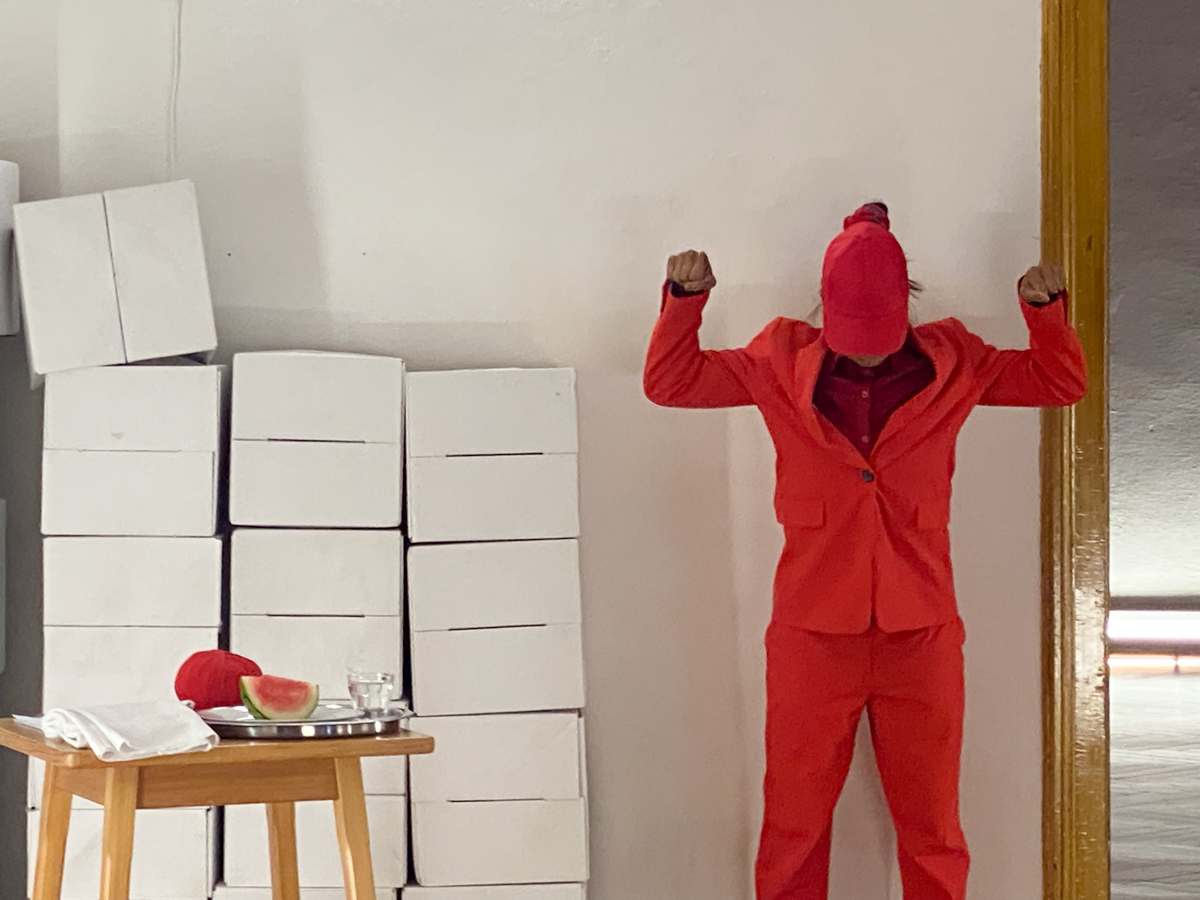
Jye-Hwei Lin about the creation process towards "kompositionen1-4"
+++ Deutsche Übersetzung im Anschluss +++
I remember the day we sat around the kitchen table with paper in hands. Andrea was sharing the concept - Kompositionen, her inspiration and a striking scene of Maria’s dance from previous year. This is the meeting point where ideas are being visualized and words pass on from body to body. It is where I find myself arrive at “working”.
Early in the process, we felt it is important for each one of us to find out what felt important to anchor ourself along the way. We spent some time, go and search individually, to fill ourselves. Words, dreams, reflects, possibilities. For a little while, we were on our own universe. Yet we stay close with each other’s parallel universe. Time seems fast, one simply follows each pull from the inner voice. Each day seems to have something new awaiting to be discovered. Every little thing becomes important.
As we move forward, like streams join together to form a river. How do we divert the stream to form a ground that can contain all bodies of water. How do we see the space? How do we inhabit ourselves in a collective creating space? How do we stay connected with what felt honest to each one’s own process?

Negotiations and compromises. Exciting and overwhelming.
Together we build out thoughts and materials. We ask questions, exchange perspectives. We trash some ideas and build new constructions. We agree some and disagree some. The constant effort to blur the boundaries. To scratch the surface and to see what we don’t see. Patience and trust. Bodies in space. Present tense. Physical and mental experiences. From the past to encounter new experiences. Where does this dance work situate in the here and now?
Ichi-go ichi-e ( 一期一會), One time One meet. With the artistic direction of Andrea, with the amazing colleagues that I get to be with- Unita, Neja, Maria and Roman. I feel privileged and in awe to be sharing this journey with you all.
Photos: Andrea K. Schlehwein, Roman Zotter
DEUTSCH
Jye-Hwei Lin über den Entstehungsprozess von "kompositionen1-4"
Ich erinnere mich an den Tag, als wir mit Zetteln in den Händen um den Küchentisch saßen. Andrea sprach über ihr Konzept – Kompositionen, was sie inspirierte, und sie zeigte uns eine eindrucksvolle Szene von Marias Tanz aus dem vergangenen Jahr. Das ist der Ort des Zusammentreffens, in dem Ideen visualisiert und Wörter von Körper zu Körper weitergegeben werden. Es ist hier, wo ich mich beim "arbeiten" einfinde.
Zu Beginn des Prozesses war es uns wichtig, dass wir alle für uns selbst herausfinden, was uns wichtig erscheint, um uns selbst entlang des Weges zu verankern. Wir nahmen uns Zeit, individuell auf die Suche zu gehen, uns anzureichern. Worte, Träume, Reflektionen, Möglichkeiten. Eine Zeit lang befanden wir uns in unserem eigenen Universum. Und doch bleiben wir nah dran an den Paralleluniversen der anderen. Die Zeit erscheint schnell, man folgt jedem Drängen der inneren Stimme. Jeder Tag hält etwas Neues bereit, das entdeckt werden will. Jede Kleinigkeit ist bedeutsam.
Im Laufe der Zeit bewegen wir uns wie Bäche, die sich zu einem Fluss vereinen. Wie lenken wir diesen Strom, um eine Grundlage zu bilden, die alle Gewässer aufnehmen kann? Wie sehen wir den Raum? Wie erschließen wir einen gemeinsamen Gestaltungsraum? Wie bleiben wir mit dem verbunden, was sich für den eigenen Prozess ehrlich anfühlt?
Verhandlungen und Kompromisse. Spannend und überwältigend.
Gemeinsam erarbeiten wir Gedanken und Materialien. Wir stellen Fragen, tauschen Perspektiven aus. Wir verwerfen manchen Ideen und arbeiten an neuen Konstruktionen. Über manches sind wir uns einig, über anderes uneinig. Ein ständiges Bemühen, die Grenzen zu verwischen. An der Oberfläche zu kratzen und zu sehen, was wir nicht sehen können. Geduld und Vertrauen. Körper im Raum. Gegenwart. Körperliche und geistige Erfahrungen. Aus der Vergangenheit auf neue Erfahrungen stoßen. Wo verortet sich dieses Tanzstück im Hier und Jetzt?
Ichi-go ichi-e ( 一期一會), Ein Zeitraum, ein Zusammentreffen. Unter der künstlerischen Leitung von Andrea, mit den wundervollen Kolleginnen und Kollegen, die mich umgeben – Unita, Neja, Maria und Roman. Ich fühle mich privilegiert und bin voller Staunen, dass ich diese Reise mit euch allen teilen kann.
Fotos: Andrea K. Schlehwein, Roman Zotter
Übersetzung: Roman Zotter